
Train Travel Beyond London
Train travel is one of the easiest ways for visitors to see the UK outside London. The ticket system can look confusing, because the same journey can be sold as several ticket types, each with its own rules on time, flexibility and refunds. This guide explains the main types in general terms and what to check before you travel.
Train tickets are separate from entry requirements. A rail ticket does not show whether you can enter the UK. For that, see the UK ETA requirements guide.
How the UK Rail System Works
Trains are run by several train operating companies. Each runs its own routes and sets its own ticket conditions within the national rules. A ticket may name a route or a train company that you must use, so read the ticket before you travel.
National Rail is the public information and ticketing service. It offers tickets from the operators that can complete the sale, but it does not sell tickets directly. Do not assume every operator has identical policies on changes, refunds or reservations.
Advance Tickets
Advance tickets are usually the cheapest option on a booked journey, but they are the least flexible. They are sold in limited numbers on a first come, first served basis. You can usually buy them up to 12 weeks before travel. On many routes they stay on sale until the day of travel, sometimes up to 10 minutes before departure.
- Each ticket is valid only on the date and train shown, and is a single journey. A return needs two tickets.
- You can usually change the date or time until the journey starts. A change fee may apply, plus any difference in fare.
- They are non-refundable, except where your train is delayed or cancelled and you decide not to travel.
- You cannot break the journey, except to change between trains.
Anytime Tickets
Anytime tickets have no restrictions on the time of travel, so they suit visitors whose plans may change. Anytime Day singles and returns are the exception: they are valid only on the date shown. Anytime singles are valid for 2 days from the date on the ticket. Most Anytime returns are valid for 5 days from the outward date, with the return portion valid for one calendar month. You can break your journey at stations along the route shown on the ticket.
Off-Peak and Super Off-Peak Tickets
Off-Peak tickets can be bought at any time before travel. They are valid only at certain times. National Rail says off-peak hours begin at 09:30 from Monday to Friday in cities and large towns, and at 09:00 everywhere else. Weekends and bank holidays are off-peak all day.
Where a journey has more than one Off-Peak fare, the Super Off-Peak is the cheaper one, with more restrictions. Read the restriction code on any Off-Peak or Super Off-Peak ticket. It shows the times and routes where the ticket is valid. Off-Peak Day tickets, and the outward part of Off-Peak tickets, are valid only on the date shown.
Comparing Ticket Types
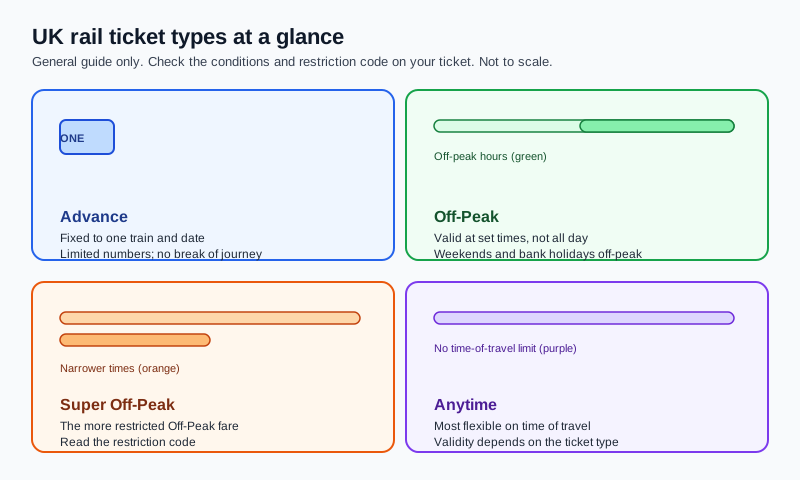
This table summarises the main rules. It is a general guide. The conditions on your ticket and the operator’s terms control the journey.
| Ticket type | Flexibility | Typical restrictions | Best use |
|---|---|---|---|
| Advance | Low. Fixed to one train and date | Limited numbers; single journeys; cannot break journey except to change trains; usually non-refundable | Fixed plans booked early |
| Off-Peak | Medium. Valid at off-peak times | Off-peak hours start at 09:30 weekdays in cities and large towns, and 09:00 elsewhere; check the restriction code | Travel outside peak hours and at weekends |
| Super Off-Peak | Lower. More restricted than Off-Peak | Narrower times and routes; check the restriction code before travel | Set journeys where the times suit you |
| Anytime | High. No time-of-travel limit, except Anytime Day tickets | Singles valid for 2 days; returns usually valid for 5 days outward | Plans that may change |
Railcards and Eligibility
A railcard gives a discount on eligible fares. Each has its own eligibility rules, so check the current criteria before you buy.
- 16-17 Saver: for anyone aged 16 or 17, with 50% off most train fares.
- 16-25 Railcard: for anyone aged 16 to 25 in full-time education, with 1/3 off. National Rail lists separate rules for mature students.
- 26-30 Railcard: for anyone aged 26 to 30, with 1/3 off.
- Disabled Persons Railcard: for eligible disabled people, with 1/3 off for you and an adult companion.
- Family & Friends Railcard: for up to 4 adults with up to 4 children aged 5 to 15. Adults get 1/3 off and children get 60% off.
- Network Railcard: for travel within a defined area of London and the South East, with 1/3 off. Anyone aged 16 and over can buy it.
- Senior Railcard: for anyone aged 60 and over, with 1/3 off.
- Two Together Railcard: for two people aged 16 and over travelling together, with 1/3 off their fares.
- Veterans Railcard: for UK veterans, with 1/3 off for you and one named companion.
National Rail’s railcard page does not say whether any railcard is open to overseas visitors, and it does not state a UK residency or address requirement. Check the conditions and the proof of identity before you buy. The page lists a passport, a driving licence (excluding Northern Ireland) and an EEA national identity card as accepted proof for certain railcards.
This guide does not list railcard prices, which National Rail’s pages state differently in different places. Check the price when you buy.
Buying Tickets Online and at Stations
You can buy tickets through the National Rail website or app, or through a train company’s own website or app. You can also buy at a staffed station ticket office or from a ticket machine. Availability varies by station and by ticket type, so ask at the ticket office if you are unsure which ticket fits your journey.
On some routes in London and the South East, you can use a contactless card or device to pay as you go. Touch in at the start of your journey and touch out at the end. This is separate from buying a fixed ticket, and the London public transport guide explains how it works within the city.
E-Tickets and Collection
The National Rail pages we reviewed do not set out one rule for how every ticket is delivered. Whether you receive an electronic ticket, a paper ticket to collect or another format depends on the ticket and the operator. Check the delivery method when you buy.
Seat Reservations
A seat reservation is optional on most tickets. Anytime tickets normally include a free reservation when booked at the same time as the ticket, and National Rail recommends one for busy or long journeys. With an Advance ticket, you can reserve a seat when you buy. Not every service offers reservations, and a ticket without one is still valid for the date and service it names.
Changes, Refunds and Restrictions
- Delayed or cancelled service: if your train is delayed or cancelled and you decide not to travel, Off-Peak and Anytime tickets can be refunded without an admin fee.
- Other reasons: Off-Peak and Anytime tickets can usually be refunded until 23:59 on the day before the ticket becomes valid, and an admin fee of up to £5 may apply.
- Changing the date: Anytime tickets can be changed without an admin fee until 23:59 on the day before the ticket becomes valid. Off-Peak tickets usually need to be cancelled and bought again before 23:59 on the day before travel.
- Travelling outside the ticket’s rules: you may have to pay the difference to an Anytime fare, and a penalty fare may also apply.
Operators can have policies beyond these national rules, so confirm the terms of your own ticket before you buy.
Split Ticketing Considerations
Breaking a journey means getting off at a station between your start and end points and continuing later. National Rail says most Off-Peak and Super Off-Peak tickets can be broken at any point and more than once, unless the ticket says otherwise. Anytime tickets can also be broken, but some may need a specific route or train company.
Advance tickets are the main exception. You are not allowed to break a journey on an Advance ticket, except to change between trains. Before you split a journey, check each ticket’s restriction code and validity with the Ticket Validity Finder on National Rail’s site. The National Rail Conditions of Travel cover breaking a journey in more detail. Do not assume a split is allowed simply because it is cheaper.
Travelling With Children
National Rail says Anytime tickets for children aged 5 to 15 are discounted by 50%. The Family & Friends Railcard gives children aged 5 to 15 a 60% discount when travelling with up to four adults. Age limits and child fares can differ between operators and ticket types, so check the rules on the booking page for each child.
Delays and Disruption
Engineering work, weather and other events can change train services. Check the operator’s updates before you leave, and allow a margin if your journey connects with a flight, ferry or another train. Refund rules for delays are described above. Some operators run their own compensation schemes, and their terms differ.
Accessibility and Assistance
National Rail’s Passenger Assist service helps disabled passengers and anyone who needs help around the station and on the train. National Rail says it is always best to book as far ahead as possible. Train companies accept requests up to 2 hours before the journey is scheduled to start.
- Phone: 0800 022 3720, then press 1.
- Text: 60083, Monday to Friday, 09:00 to 17:00.
- What it covers: help around the station, boarding and leaving trains, being met at connections, ramps, support for non-visible impairments, and help with up to three items of luggage that one person can manage.
Assistance does not replace a ticket. National Rail says you must hold a valid ticket before travelling. If an impairment stops you buying one beforehand, you will not have to pay more than you would have before boarding. Buy your ticket before you request assistance where you can.
Common Tourist Mistakes
- Booking an Advance ticket for a different date or time than the journey you intend to make.
- Breaking a journey on an Advance ticket, which is not allowed except to change trains.
- Ignoring the restriction code on an Off-Peak or Super Off-Peak ticket.
- Expecting every operator to have the same refund, change or reservation policy.
- Assuming a railcard discount is open to every visitor without checking.
Practical Booking Checklist
- Decide whether your plans are fixed (Advance may suit) or flexible (Anytime or Off-Peak may suit).
- Check the date, train and validity printed on the ticket before you travel.
- Read the restriction code and the change and refund conditions.
- Check whether a railcard applies, and check its eligibility and proof of identity.
- Decide whether a seat reservation matters for your journey.
- If you need assistance, book Passenger Assist and buy your ticket first.
Frequently Asked Questions
Can I buy a train ticket on the day?
Off-Peak and Anytime tickets can be bought at any time before travel. Advance tickets may remain available until the day of travel on many routes, but they can sell out first.
Do all UK train companies have the same ticket rules?
No. National Rail sets out common ticket types, but operators can have different policies on changes, refunds, reservations and compensation.
Can I use a railcard if I am visiting from overseas?
National Rail’s railcard page does not say whether railcards are open to overseas visitors. Check the eligibility conditions and the accepted proof of identity before you buy.