
Getting Around London
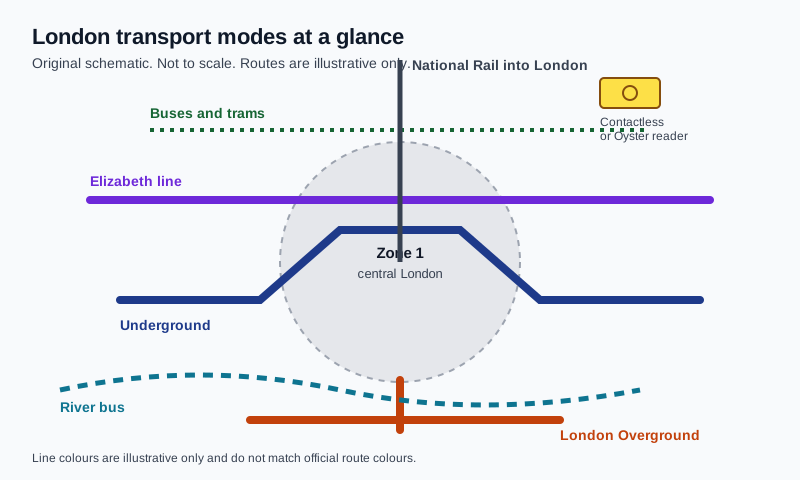
London’s transport network combines several systems: the Underground, buses, trams, the Elizabeth line, the London Overground, the DLR and National Rail services into the city. Each has its own ticketing rules, but they share the same card readers. Once you understand the basics, the network is straightforward.
This guide covers what you can pay with, how to tap in and out, how fare zones and daily caps work, and what to check for children and late-night travel. Fares and service details change, so confirm them on the Transport for London website and your rail operator’s site before you travel.
Understanding the London Underground
The Underground, usually called the Tube, is often the fastest way across central London. Each line has a colour on the Tube map and runs between two named end stations. Many stations are deep underground, so expect long escalators and staircases at some of them.
Reading Tube Maps and Station Signs
The Tube map is a diagram, not a geographical map. Distances are not to scale, and central stations are spaced out more than they look. Use the map to find your line and direction, not to judge how far apart stations are.
- Find your station and note its line colour.
- Check the end-of-line station on the platform sign. That name tells you the direction of travel.
- At interchanges, follow the sign for your line rather than the one you are leaving.
- Note the zone numbers on the map if you want to see how fares are calculated.
London Buses and When to Use Them
Buses are often the best choice for shorter journeys, for seeing the streets, and for places the Underground does not serve directly. On buses you only tap in when you board. Visit London says the Hopper fare allows unlimited bus journeys within one hour of tapping onto your first bus. Check the route number and destination on the display before you board.
Elizabeth Line or Underground?
The Elizabeth line runs east to west across central London, with fast services between stations that are far apart on the map. It connects with several Underground lines at major central stations, including Paddington, Bond Street, Tottenham Court Road and Liverpool Street. It uses the same contactless and Oyster readers as the Tube.
Choose the Elizabeth line for long east-west trips, or where it connects directly to your station. Both use the same zones and daily cap, so the choice is about time and convenience.
London Overground and National Rail
The London Overground is a TfL-run network that serves areas outside the Tube core, and it accepts contactless cards and Oyster cards. National Rail services into London are run by different train operators. Visit London says Oyster can be used on most National Rail services within Zones 1 to 9, but not on the Heathrow Express or Southeastern high-speed services.
National Rail rules differ by route
National Rail says pay as you go with contactless works on National Rail, the Underground, the DLR, London buses and trams within London, and at a growing number of stations across the South East. Before you touch in, check that your destination accepts it.
Contactless Cards and Mobile Payments
Most visitors can pay with a contactless bank card, or with a phone or wearable set up for contactless payment. Touch the same card or device on the yellow reader at the start and end of a journey, where tapping out applies. Visit London says contactless works on the Tube, DLR, London Overground and most National Rail services in London.
If your contactless card was issued outside the UK, check with your bank whether international transaction fees apply, because these add to the cost of each journey.
Oyster Cards for Visitors
An Oyster card is a reusable smartcard that you load with pay-as-you-go credit. It is not personalised, so you do not need to give personal details to buy one. A non-refundable card fee applies, and two people cannot use the same card on the same journey.
A standard Oyster card can be bought at Underground ticket machines, TfL Visitor Centres, Oyster Ticket Stops and airport TfL and rail stations. A Visitor Oyster card is pre-loaded, but it must be ordered online before you arrive, and it cannot be bought at an airport on arrival. Visitor Oyster cards cannot be registered online.
Understanding Fare Zones
London’s network is divided into nine travel zones, with Zone 1 covering central London. Most visitors spend their time in Zones 1 and 2. A journey from Zone 1 to Zone 2 costs more than one that stays inside Zone 1, so check which zones your route crosses on the map or in the journey planner.
Peak and Off-Peak Travel
Visit London gives the peak periods as Monday to Friday from 6.30am to 9.30am and 4pm to 7pm. Off-peak fares apply at other times, including weekends and bank holidays. Travel to Heathrow Airport is charged at peak rates at all times. Travelling outside the peaks is cheaper and less crowded, which matters when you carry luggage.
Daily Fare Caps and Ticket Choices
Oyster and contactless both use daily caps. Visit London explains that once you reach the daily maximum for Tube and rail travel, all further Tube and rail journeys that day are free. Caps apply to the card or device you use for every journey. River bus journeys are charged separately, and do not count towards the Tube and rail cap.
National Rail says capping does not apply to journeys that do not include Zones 1 to 9. The cap amounts and the weekly cap rules change over time, so this guide does not list them. Check the TfL fares pages before you plan your budget.
| Transport type | Best use | Ticketing notes | Important considerations |
|---|---|---|---|
| Underground (Tube) | Fast travel across central London and to most sights | Tap in and out with contactless or Oyster; daily cap applies | Many stations are deep; check step-free access |
| Elizabeth line | East-west trips across the centre and links to Underground lines | Tap in and out with contactless or Oyster; daily cap applies | Outer stations can have different rules; check before you travel |
| Buses and trams | Shorter trips and places the Tube does not serve | Tap in only when boarding; no tap out | Check the route number and destination on the display |
| London Overground and DLR | Areas outside the Tube core and east London | Tap in and out with contactless or Oyster; daily cap applies | Check the line on the map; some stations are far from the centre |
| National Rail within London | Suburban and cross-London train journeys | Contactless or Oyster on most services; check each route | Rules differ by operator; a missed tap-out can cost up to £30.40 |
| Heathrow Express | Non-stop trips between Heathrow and Paddington | Oyster is not valid; check the ticket type before you board | See our airport guide for Heathrow routes |
How to Tap In and Tap Out
On the Tube, DLR, London Overground, the Elizabeth line and most National Rail services within London, tap in when you enter the station and tap out when you leave. Gates may be open at some stations, but you still need to tap.
- Use the same card or device for your tap in and your tap out.
- Touch only one card or device on the reader at a time. If you carry an Oyster card and bank cards in one wallet, hold only the Oyster card to the reader.
- Wait for the reader to beep and show a green light before you walk through.
- Keep your phone or wearable charged, because a dead battery can prevent a tap out.
- On buses and trams, tap once when you board and do not tap out.
If you do not tap out, National Rail says the journey is recorded as incomplete and can be charged a maximum fare of up to £30.40. Some interchanges require you to tap out and back in when you change trains, so check the rules for the station where you change.
Travelling With Children
Visit London summarises the rules for children this way:
- Children under five travel free on all London transport with a fare-paying adult.
- Children aged five to ten travel free on the Tube, DLR and London Overground with a fare-paying adult, up to four children per adult. A 5-10 Zip Oyster photocard is needed if a child travels without an adult.
- Children aged 11 to 15 need their own payment method. UK residents can apply for an 11-15 Zip Oyster photocard. Visiting families can ask TfL staff to add the Young Visitor discount to a standard Oyster card, which gives 50% off adult fares for up to 14 days.
Children and contactless
National Rail says child fares are not available on pay as you go with contactless. A child travelling on pay as you go is charged the adult fare and needs their own card or device. Child-rate fares on Oyster are linked to a photocard, so check the rule for your route and payment method before you travel.
Luggage and Accessibility
Many Underground stations have steps, escalators and long corridors. Step-free routes vary from station to station, and a lift can be out of service. Check the access information for each station on your route before you travel with heavy luggage, a pushchair or a mobility aid. Peak hours are the most crowded, so travel off-peak where you can.
Travelling Late at Night
Visit London says Oyster cards can be used at any hour, including on the Night Tube. That does not mean every line runs all night. Night Tube services run on some lines at weekends. Check the TfL journey planner for your line and date before you rely on a late train, and use night buses when the Tube is closed.
Common Mistakes Visitors Make
Forgetting to tap out
A missed tap-out creates an incomplete journey, which can cost up to £30.40 on National Rail. Tap out at every exit where tapping applies.
Using two cards for one journey
Only one card should touch the reader at a time. Tapping out with a different card from the one you used to tap in creates two incomplete journeys.
Assuming Oyster works everywhere
Oyster is not valid on the Heathrow Express or Southeastern high-speed services. Check the rules for your route.
Expecting child fares on contactless
National Rail says child fares are not available on pay as you go with contactless, so check before you pay.
How to Plan a Route
Use the TfL journey planner or a map app for each journey. Enter your start and end points, then check the line changes and the time. Check the service status for your line before you leave, because engineering work and closures are common.
Our London 3-day itinerary groups sights by area, which makes routes easier to plan. If you are arriving at an airport, the airport transfer guide explains each route.
Frequently Asked Questions
Do I need an Oyster card if I have a contactless card?
No. A contactless bank card or phone works on most London services in the same way. An Oyster card is an alternative, and some discounts apply to it. Check the rules for your route.
Does the Tube run all night?
Not on every line. Night Tube services run on some lines at weekends. Check the TfL journey planner for your line and date.
First-Day Transport Checklist
- Check which card or device you will use, and that it works for contactless payment.
- Check that your phone or wearable has enough battery for the day.
- Note your accommodation’s nearest station and its lines.
- Check the service status for your route on TfL or your rail operator.
- Tap in and out using the same card or device each time.
Entry requirements depend on your nationality and circumstances, so check the UK ETA requirements guide before you travel. If you are eligible, you can start an application here: Start your UK ETA application.