
Quick answer
The Home Office holds and processes personal information from ETA applications and from the ‘check your ETA’ service. The official privacy notice says the decision to issue an ETA is automated, but complex or adverse decisions are always taken by a trained officer or caseworker. Once an application is submitted, it may not be possible to withdraw it, because processing starts straight away. Facial biometrics are typically kept for three years, and other personal data for 15 years after the last case action. You have data protection rights, which are explained in the notice.
Who holds the data
The privacy notice is published by the Home Office. It explains how the department handles information supplied or collected through ETA applications and through the ‘check your ETA’ service. An ETA provides permission to travel to the UK, and the Home Office uses the information to decide applications and to protect the border.
The legal basis for processing
The notice says personal information is used only where there is an appropriate legal basis under the UK General Data Protection Regulation (UK GDPR) or the Data Protection Act 2018. For ETA applications, the Home Office relies on a task carried out in the public interest, or the exercise of official authority. Special category data, such as biometric information, is processed on the basis of substantial public interest under domestic law.
Automated decisions and human review
The notice says the decision to issue an ETA is automated. Complex or adverse decisions are always taken by a trained officer or caseworker, so a person reviews the cases where the outcome is more involved or unfavourable.
The UK GDPR gives people the right not to be subject to a decision made solely by automated processing where that decision produces legal or similarly significant effects, unless the law allows it with safeguards. The notice says that if you do not want your application considered by an automated process, you can apply for a visit visa instead. The official guidance now calls this route a Standard Visitor visa.
Can you withdraw an application?
Not always. The notice says the Home Office starts processing ETA applications instantly, so it may not be possible to withdraw an application once it has been submitted. Check your details carefully before you submit.
How long the information is kept
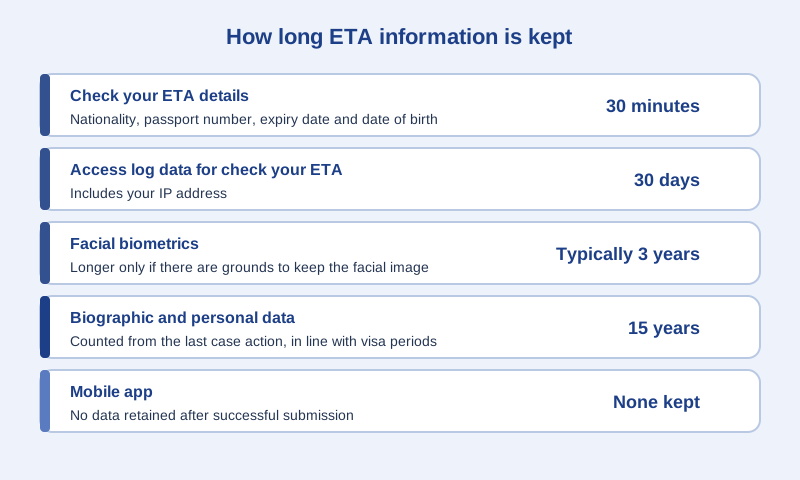
The notice sets out the following retention periods. It also says that retention periods are kept under review to make sure they meet the Home Office’s border and immigration functions.
| Information | Retention stated in the notice |
|---|---|
| Facial biometrics | Typically kept for three years, unless there are grounds to keep the facial image for longer |
| Biographic and personal data | Kept for 15 years after the last case action, in line with visa retention periods |
| Mobile app | After successful submission, the app does not retain any data |
| Check your ETA: nationality, passport number, passport expiry date (if entered) and date of birth | Kept for 30 minutes from your last activity, or less if you choose to finish and leave the service |
| Check your ETA: access log data, including your IP address | Deleted after 30 days |
The table is a summary of the notice. Read the full notice for the wording and any changes made after this article was published.
Your data protection rights
The Home Office notice for borders, immigration and citizenship explains that, under the UK GDPR, you can ask to access your personal information. You can also ask the Home Office to rectify or delete it, and to object to or restrict its use. Where consent was requested for processing, you can withdraw it.
You can make a subject access request to the Home Office. The notice also says not to use that route for proof of your immigration status or for UK Visas and Immigration (UKVI) account registration. For those, use the UKVI services instead. If you are not satisfied with how your data has been handled, the notice explains that you can complain to the Home Office data protection officer, and that you have the right to complain to the Information Commissioner’s Office (ICO).
The difference between the Home Office and this website
This article explains the Home Office’s processing. Questions about how the Home Office uses ETA information should be directed to the Home Office, using the routes set out in its notice.
UKETA.sg has its own privacy policy, which explains how this website handles information you give us. That policy is separate from the Home Office notice, and this article does not replace it.
Common misunderstandings
“An automated decision means nobody reads my application”
The notice says complex or adverse decisions are always taken by a trained officer or caseworker.
“I can cancel my application at any time”
The notice says that processing starts instantly, so withdrawal may not be possible once the application is submitted.
“This website can remove my Home Office records”
Requests about Home Office records go to the Home Office, using the routes in its notice.
Frequently asked questions
Will my data be kept after my trip?
The notice says biographic and personal data is kept for 15 years after the last case action, and facial biometrics are typically kept for three years. The periods are kept under review.
Can I opt out of automated processing?
The notice says that if you do not want your application considered by an automated process, you can apply for a visit visa instead.
Does the ETA app keep my data?
The notice says the mobile app does not retain any data after successful submission.
Next steps
Read the official privacy notice before you apply, check your details carefully, and use the routes in the notice for any request about your Home Office data. If you need an ETA and are ready to apply, you can start now.