
Quick answer
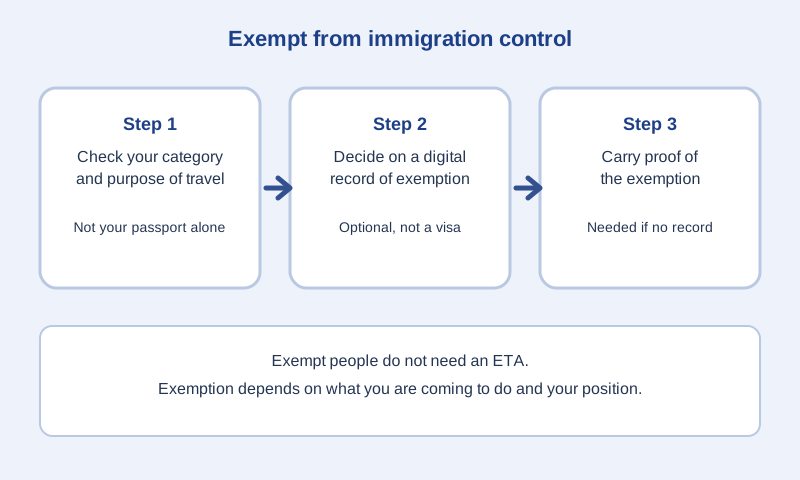
People who are exempt from UK immigration control do not need an ETA. The exemption depends on what you are coming to the UK to do and on your position, not on the passport you hold. A digital record of exemption is available and can help you show your status, but it is not mandatory. If you are exempt and have no record, you will need to show documents that prove the exemption.
What exempt from immigration control means
Some people are exempt from immigration control when they travel to the UK for specific purposes, even though they do not have the right to live in the UK. The official guidance says these people are not subject to the Immigration Rules and do not need an ETA. That is different from holding a visa, and it is different from having permission to live, work or study in the UK.
The exemption is linked to the reason for the journey and to the person’s role. Two main groups are covered: non-armed forces categories and armed forces categories. Each group has its own eligibility guidance, and qualifying family members can fall within them.
Non-armed forces categories
The official guidance lists six main non-armed forces categories:
- people posted to diplomatic missions in the UK;
- consular officers and employees based in the UK;
- sovereigns and heads of state;
- members of governments;
- people attending an international conference; and
- employees of international organisations.
The full eligibility rules for each category are set out in the official guidance. If you think you fall into one of these groups, check the detailed criteria rather than relying on your job title alone.
Armed forces categories
The official guidance lists five main armed forces categories:
- full-time members of the home forces who are subject to service law. Regular forces personnel are always subject to service law;
- reservists who are deployed or due to be deployed. Reserve forces are exempt only when they are subject to service law;
- members of international armed forces, such as a Commonwealth force, who are training in the UK with part of the home forces, including NATO forces;
- members of a visiting force, who serve or are posted for service in the UK under the relevant visiting forces legislation; and
- members of an international headquarters or defence organisation, including relevant NATO forces.
Armed forces eligibility depends on the specific category and the service status of the person. Check the detailed criteria before relying on the exemption.
Why the passport you hold is not enough
Exemptions from immigration control are based on what you are coming to do in the UK and on your position. They are not based on the travel document you hold. The official guidance says a particular type of passport is not sufficient on its own.
The digital record of exemption
Digital records of exemption have replaced exempt vignette stickers in passports. The official guidance says a digital record is not a visa. If you already hold a valid exempt vignette sticker, you may keep using it for its full validity period, provided you remain exempt from UK immigration control.
| Question | What the official guidance says |
|---|---|
| Who can apply | People who do not normally need a visa to work in the UK because they are exempt from immigration control |
| Is it compulsory | No. It is not mandatory, but it can help you avoid delays when you enter the UK |
| Where you can apply | Outside the UK, or inside the UK from 19 March 2026 |
| What you need to set up | A UK Visas and Immigration (UKVI) account, which is the same account used for eVisas |
| What it helps with | Showing your exemption when required, and letting carriers such as airlines confirm your status automatically |
Travelling without a digital record
You do not have to have a digital record to be exempt. If you are exempt from immigration control but do not have a record, the official guidance says you will need to show documents that prove the exemption. Have those documents ready for check-in and for the border.
Exemption from immigration control and exemption from obtaining permission to enter are separate questions. Crew members have their own permission-to-enter rules, which are covered in our guide to seafarers, aircrew and rail crew.
Common misunderstandings
“I need a digital record to be exempt”
No. A digital record is optional. It is a way to show your status, not the source of the exemption.
“A digital record of exemption is a visa”
No. The official guidance says digital records of exemption are not visas.
“Any diplomat or official automatically needs no ETA”
Exemption depends on the category and the purpose of the journey, and the detailed criteria apply. Check the category rather than assuming it.
Frequently asked questions
Do I need an ETA if I am exempt from immigration control?
The official guidance says people who are exempt from immigration control do not need an ETA.
What happens to my old exempt vignette sticker?
If you hold a valid sticker, you may keep using it for its full validity period, provided you remain exempt.
Can I apply for a digital record while I am in the UK?
Yes. From 19 March 2026, the official guidance says you can also apply inside the UK.
Next steps
If you are exempt from immigration control, check the category that applies and decide whether a digital record would help. If you are not exempt and need an ETA, you can start your application now.