
Most of what is written about the UK ETA stops at the moment it is approved. The part that makes travellers nervous comes later: the arrivals hall, the queue, and the question of whether an officer will want to speak to you. This guide covers that stretch. It explains what an ETA does and does not do once you land, who can use the automatic eGates, when you are sent to an officer instead, and how to arrive prepared without carrying a folder of paperwork. It reflects published guidance as of 10 October 2026, and border procedures change, so read it as a calm overview rather than a promise of how your arrival will go.
The short answer
- An ETA does not guarantee entry. It is permission to travel to the UK and to seek entry. Permission to enter is decided at the border, by an officer or, for some travellers, through an eGate.
- You can use an eGate if you meet the conditions. They include a biometric passport, being old enough and tall enough, holding a valid ETA, and being a national of one of the listed countries or a Registered Traveller.
- Some travellers must see an officer. The clearest published example is a Creative Worker concession traveller, who needs a passport stamp that a gate cannot give.
- You do not need to print anything for the ETA. It is linked to your passport digitally, so the passport is the thing to carry.
- Supporting documents are usually useful rather than mandatory. A little preparation beats a large bag of paper.
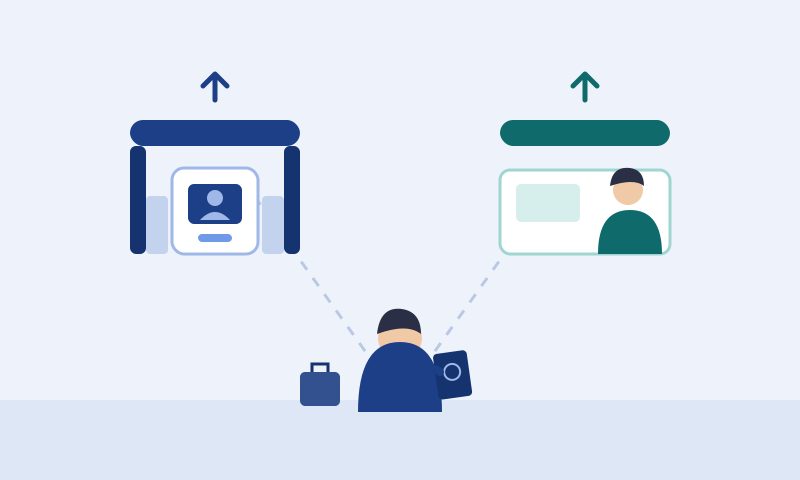
From application to entry: seven stages
Much of the confusion about arrival comes from treating several separate events as one. They are different, and the ETA only covers the first few.
| Stage | What it is | Who decides |
|---|---|---|
| 1. Application | You submit details, a passport and a photo. | You, then the immigration authorities assess it. |
| 2. ETA granted | Your approval is confirmed by email. | The immigration authorities. |
| 3. Permission to travel | The ETA allows you to travel to the UK to seek entry. | Granted by the ETA itself. |
| 4. Carrier check | Your airline or ferry operator checks your travel documents before boarding. | The carrier decides whether to let you board. |
| 5. Arrival | You land and head for passport control. | Not a decision point. |
| 6. Border control | Your passport is checked at a gate or by an officer. | Border Force. |
| 7. Permission to enter | You are allowed in, usually as a visitor for a limited period. | Border Force, through an officer or an eGate. |
Carriers send the passenger information they collect to Border Force electronically before you arrive, so the passport you check in with matters. Our guide to refused and rejected ETA applications explains why a refusal of an ETA is a different event from a refusal at the border.
Is the ETA a document you carry?
No. An ETA is a digital record. It is linked to the passport you applied with, and the published guidance says you do not need anything else to show you have one. There is no sticker, stamp or card to keep, and the guidance does not ask you to print anything.
Many people still keep the confirmation email, with the reference number, somewhere easy to find. That is a sensible personal record. It is not a document anyone is required to ask for at the border. What matters is that you travel on the same passport the ETA was granted for, and that the passport is valid for the whole of your stay. We cover what happens if that passport changes in our guide to ETA validity and new passport rules.
Who can use the eGates
The eGates are the self-service gates that compare your face with the photo in your passport. They are quicker than the staffed desks for people who qualify. The published conditions for using them include all of the following:
- your passport has the biometric symbol on its cover;
- you are at least 8 years old, and aged 8 to 17 only with an adult;
- you are at least 120 centimetres tall;
- you hold a valid immigration status, which includes a valid ETA, and you are either a national of one of the eligible countries or a member of the Registered Traveller Service.
The eligible nationalities currently named are the EU countries, Australia, Canada, Iceland, Japan, Liechtenstein, New Zealand, Norway, Singapore, South Korea, Switzerland and the United States. National identity cards cannot be used at the gates, so a European traveller who arrives with an ID card is sent to an officer.
What using a gate means
A gate does the identity check and, for eligible visitors who hold no visa, the border system treats the entry as a visitor entry of up to six months without a stamp in the passport. The gate is simply the quicker route to the same decision. It is still a border check, it does not replace one, and it can send you to an officer. Using a gate does not guarantee admission.
If your nationality is not on the list
Travellers from other ETA nationalities, such as Malaysia, Brazil, Mexico or Argentina, are not on the current gate list and use the staffed passport lanes. Some may qualify as Registered Travellers, a paid membership with its own eligibility rules, including having visited the UK several times in recent years. Because the answer depends on nationality, our country guides set out the position for each, such as the guide for US citizens, rather than repeating all of it here.
The contactless gates
A newer contactless gate began a phased rollout in October 2026, limited at first to British citizens. Passengers must still carry a valid passport, and ETA travellers should use the standard gates or the staffed lanes.
Children and families at the gates
The rules for children are the part that surprises families, because the age and height limits are not the same as the ETA’s own rules. This section stays on the border. For how children and babies apply for an ETA, see our guide to ETAs for children, babies and families.
- A child must be at least 8 and at least 120 centimetres tall to use a gate, and a child aged 8 to 17 must be accompanied by an adult.
- Younger or shorter children go through the staffed lane, and the guidance asks families to stay together at passport control.
- Only one person uses a gate at a time. An adult travelling alone with children should go through first. Where two adults travel with children, the suggested order is one adult, then the children, then the other adult.
- Relationship questions can arise if an adult does not appear to be the child’s parent, for example because of a different surname. Documents that help are a birth or adoption certificate, a marriage or divorce certificate where surnames differ, or a letter from the child’s parent giving permission and contact details.
If one family member is not eligible for the gates, the family can use the staffed lane together, which is often simpler than splitting up.
When you must see an officer
There are two different situations here: people who are told to see an officer, and people who simply cannot use a gate.
The Creative Worker concession
The published guidance names one group who must see a Border Force officer and have their passport stamped: people entering with a Creative Worker certificate of sponsorship for a short assignment of up to three months. A gate cannot give the stamp, and without it the traveller cannot do the activities that brought them to the UK. If a person uses a gate by mistake, they should see an officer before leaving the port to get the stamp. Our Creative Worker concession guide covers the route itself.
Travellers who are simply not gate-eligible
Anyone who does not meet the conditions above uses the staffed lanes, including travellers whose nationality is not on the list, passports without the biometric symbol, children below the age or height limits, and people travelling on an ID card. There is nothing to read into that.
Referrals from the gate
Some people who are eligible are still referred to an officer. The guidance says Border Force may not always be able to explain why, and that most people pass through without trouble. Being referred is a routine part of how the system works. Our article on ETA versus visa explains how permission to travel and permission to enter fit together.
If a gate does not let you through
The published guidance lists common reasons a gate cannot complete a check. Several are easy to avoid.
| Reason | What it means | What helps |
|---|---|---|
| User error | The passport was left in its cover, the wrong page was inserted, or it was not pressed firmly. | Remove the cover, open at the photo page and follow the on-screen steps. |
| Identification error | Your appearance differs from the passport photo, or you did not look at the screen until it turned green, or wore a hat, glasses or headphones. | Remove hats and sunglasses and look straight ahead. |
| Passport or chip error | The passport is worn or damaged, so the chip or data cannot be read. | Expect an officer check, and consider replacing a damaged passport before you travel. |
| Digital permission | The ETA, eVisa or exemption record is missing or no longer valid. | Check your ETA is valid and linked to the passport you are using. |
| Gate fault | The gate itself did not work. | Follow staff directions. |
| Safeguarding | Staff need to confirm a child’s relationship with the adult travelling with them. | Carry the relationship documents described above. |
| Border security or entry checks | Further checks are needed on identity, documents or entry requirements. | Co-operate; staff may not give a detailed reason. |
The sources reviewed do not set out a step-by-step procedure for what happens once a gate refers you. The sensible expectation, which is not a rule, is that you are directed to a staffed desk. Follow staff instructions and treat it as an ordinary check, not as a sign that something is wrong.
What an officer may ask
An officer decides whether you meet the rules for a visitor. In the published framework that means being satisfied that you are a genuine visitor: that you intend only permitted activities, that you will leave at the end of your stay, that you can support yourself, and that you are not trying to make the UK your home through frequent or successive visits. Questions are the way an officer tests those points, and they depend on the traveller.
There is no fixed script and not everyone is asked the same things. Examples of the kinds of matters an officer might want to understand include:
- the main reason for your visit and what you plan to do;
- how long you intend to stay and where you will be staying;
- your plans to leave or move on afterwards;
- how you will pay for the visit, since there is no set level of funds;
- for business or study visits, the details of the activity involved;
- whether you will be paid for anything in the UK, where relevant.
An officer does not ask for a written guarantee about how long you will stay, and whether supporting evidence is requested depends on the answers you give. The most useful preparation is not rehearsed replies but being able to describe your plans plainly and consistently. In some cases permission may be granted for a period that matches the stated purpose rather than for the full six months.
What to carry
It helps to separate what you must have from what is useful to have. The first list is short.
| Item | Status | Notes |
|---|---|---|
| Passport linked to your ETA | Required | Valid for the whole of your stay. Keep it to hand, not packed in a checked bag. |
| The ETA itself | Nothing to carry | It is held digitally against the passport. |
| Accommodation details | Useful | A hotel booking or the address of the person you are staying with. |
| Return or onward travel | Useful | A ticket or itinerary showing you plan to leave. |
| Evidence of purpose | Useful where relevant | A business invitation, event details, course information or a host’s contact details. |
| Evidence of funds | Useful if asked | Bank details or a statement showing you can meet your costs. |
| Child relationship documents | Useful for families | Needed more often when surnames differ or you are not the parent. |
None of the supporting items is a legal requirement for an ordinary tourist, and you should not feel you must bring everything. They are the kind of things that let you answer a question quickly if one is asked. For purposes that involve specific activities, our guides explain what evidence tends to matter: see tourism, business visits and visiting family and friends. Customs is a separate matter, and goods, cash above the limits and restricted items have to be declared whatever documents you hold.
At passport control, have your passport out of its holder and open at the photo page, take off sunglasses and hats, and put your phone away when it is your turn. You do not have to complete a landing card.
If entry is refused
Being refused entry is uncommon for travellers who hold an ETA and have a straightforward visit, but it is possible, because the ETA is not permission to enter. The guidance says that a person refused entry is told in writing why, whether they can appeal, and when they will be removed, and that they will usually have to leave the UK immediately. In some cases a person may be admitted temporarily, with their passport held and reporting conditions. This article does not cover individual cases, and anyone in that position should seek qualified advice.
Using the passport linked to your ETA
The ETA works only when you travel on the passport named in the application. At the border this matters in a practical way: a different passport means no ETA is linked to it. If you hold two passports, plan which one you will use from the start, as our guide to dual citizens and passport choice explains, and keep the other one out of your hand at passport control.
Example scenarios
These are hypothetical examples, written to illustrate how the process works. They are not real travellers and not predictions of what will happen to you.
A. An adult tourist who is eligible for the gates
A traveller with a biometric passport and a valid ETA, from a gate-eligible nationality, lands, takes the passport out of its cover, and uses a gate. The gate checks the face against the photo and the traveller is through. They carried only the passport.
B. A parent with a young child
A parent travels with a six-year-old. The child is below the age limit, so they go together through the staffed lane. The officer asks a couple of questions about the trip. A copy of the child’s birth certificate sat in a pocket, though nothing was asked for.
C. A passport the gate does not accept
A traveller’s passport is scuffed and the gate cannot read the chip. An officer scans it by hand and asks about the visit. The traveller resolves to replace a worn passport before the next trip.
D. A business visitor referred to an officer
A visitor attending a three-day conference is referred from the gate to an officer. The officer asks what the conference is, who invited them and how long they are staying. They explain clearly and have the event details on their phone.
E. A Creative Worker concession traveller
A performer arriving for a two-month engagement on a certificate of sponsorship goes directly to the officer, as they know a gate cannot stamp the passport. They are stamped and can start the engagement.
F. A passport that is not the one linked to the ETA
A traveller holds two passports and applied for the ETA on one, but packs the other. At check-in the airline flags that no ETA is linked to it. The traveller fixes it at home before the next trip, and learns to carry the passport that carries the ETA.
Common mistakes
- Believing an ETA is entry. It is permission to travel, and an officer decides on entry.
- Packing the passport in a suitcase. Keep it with you.
- Leaving the passport in its cover at a gate, which is a common cause of a failed read.
- Assuming everyone can use a gate. Nationality, age, height and passport type all matter.
- Using a gate when a stamp is needed. Creative Worker concession travellers must see an officer.
- Taking a referral personally. Staff may not explain it, and it is a routine step.
Arrival checklist
- Check your passport is valid for the whole stay and is the one linked to your ETA.
- Keep the passport and any key documents in hand luggage.
- Know your accommodation, your plans to leave, and any purpose-specific details for a business, study or paid element.
- For children, carry relationship documents if surnames differ or you are not the parent.
- On arrival, open the passport at the photo page, remove hats and sunglasses, and put your phone away.
- Use a gate only if you meet the conditions, otherwise join the staffed lane.
- If you need a Border Force stamp, go to an officer, not a gate.
- Answer plainly and consistently, and follow staff instructions.
Frequently asked questions
Does a UK ETA guarantee I can enter?
No. It permits you to travel and seek entry. A Border Force officer, or an eGate for those who qualify, decides on permission to enter.
Can I use an eGate with an ETA?
If you hold a valid ETA, have a biometric passport, meet the age and height conditions, and are a national of an eligible country or a Registered Traveller, you can normally use the gates. Otherwise you use the staffed lane.
Do I need to print my ETA?
No. The ETA is held digitally against your passport, and the guidance says nothing else is needed to show you have one.
Can children use the eGates?
Children aged 8 and over who are at least 120 centimetres tall can, and those aged 8 to 17 must be with an adult. Younger or shorter children use the staffed lane with their family.
What if the eGate does not accept my passport?
Common causes include leaving the passport in its cover, a damaged chip, or an appearance that differs from the photo. Staff will direct you. Treat it as an ordinary check.
Who must see a Border Force officer rather than use a gate?
Anyone who is not gate-eligible, and, among published examples, people entering on a Creative Worker certificate of sponsorship for a short assignment, who need a passport stamp.
What questions might I be asked?
There is no fixed script. An officer may want to understand your reason for visiting, how long you will stay, where you will stay and how you will support yourself. Not everyone is asked the same things.
What if I arrive with a different passport from the one on my ETA?
The ETA is not valid on a different passport. Travel on the linked one, and apply again if you have a new passport.