
Many ETA guides are written as though everyone lands at an airport. Plenty of travellers do not. They ride a train under the Channel, drive onto a ferry, or step off a ship at a port of call. If your nationality needs an ETA, the obvious question is whether the mode of transport changes anything. This guide explains what the published rules establish as of 10 October 2026, where the guidance is silent, and why we keep the cruise section deliberately cautious. It is general information, not advice on any individual case.
The short answer
- The ETA requirement is not limited to flights. The published guidance says it applies to all routes and modes of entry into the UK, including those through the juxtaposed controls, which is the term for UK border checks carried out abroad on some rail and ferry routes.
- Arriving by ferry or train is not an exemption. If you are an ETA nationality visiting the UK, you need the ETA before you travel, whichever vehicle takes you.
- Cruises are not clearly covered. The guidance we reviewed does not address cruise scenarios directly, so we cannot say that cruise passengers are exempt, and we do not.
- An ETA is not a boarding pass and not permission to enter. Operators decide who boards, and border officers decide who enters.
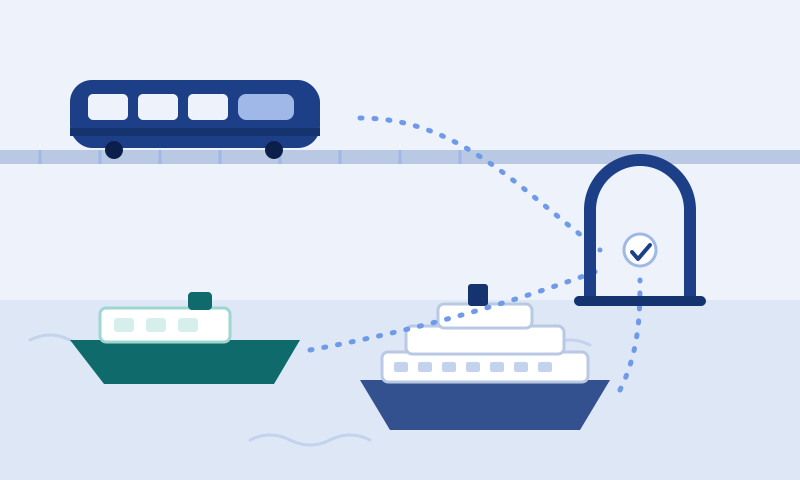
One requirement, every route
The ETA is permission to travel to the UK in advance. The decision-maker guidance for the scheme states that the requirement applies to all routes and modes of entry, naming journeys that come through the juxtaposed controls or via the Common Travel Area. Guidance on entering the UK likewise says you must have your ETA before you travel, and it does so without limiting that to air passengers.
So the useful question is not whether an ETA is needed by ferry or rail. It is whether you are someone who needs one at all, which depends on your nationality and your reason for coming. Our guide to UK ETA requirements sets that out, and the tourism guide covers what a leisure visit may include.
Air, rail, ferry and cruise compared
What changes by mode is the practical setting, not the rule. The table sticks to what the guidance supports.
| Mode | Does the ETA requirement apply? | What the published guidance says about checks |
|---|---|---|
| Air | Yes, for those who need one. | Carriers check travel documents before boarding and pass information to Border Force. |
| International rail | Yes. Juxtaposed controls are named in the guidance. | Entering via the Channel Tunnel requires producing identity and nationality documents on request. UK checks take place at some terminals abroad. |
| Ferry | Yes. | A ferry operator is given as an example of a carrier that may ask for proof of permission to travel. Border control applies on arrival. |
| Cruise | Not specifically addressed in the guidance reviewed. | No cruise-specific rules were found. Do not assume an exemption. |
What carriers do and do not do
The published guidance describes the carrier’s role in general terms. A carrier, a word that covers airlines, ferry operators and others, checks passengers’ passports and other travel documents before they board and sends that information electronically to Border Force. The guidance also says the carrier is responsible for deciding whether to allow you to board, in line with its own policies.
That is where the published detail stops. We have not found a primary source that explains how each operator verifies an ETA, whether it can see the record instantly, or what happens at a particular terminal or port. So we do not say that any operator checks your ETA in a specific way, and you should not assume that being waved through a check means you hold a valid ETA. The ETA requirement belongs to you, whether or not anyone asks about it.
Eurostar and international rail
The ETA guidance names the juxtaposed controls, the arrangement under which UK border checks happen in another country’s station or terminal before you board. Guidance on a UK faster-entry service for frequent visitors lists Paris, Lille and Brussels among the rail terminals where UK channels operate, which confirms that UK checks do take place at some international rail terminals. In plain terms, taking the train does not take you around UK immigration. It moves the check.
The rules also say that a person seeking entry through the Channel Tunnel must, on request, produce a valid passport or other document that establishes identity and nationality, and the information needed to decide whether they need permission to enter. For an ETA holder this means the passport linked to the ETA.
We do not describe station check-in steps, cut-off times or any system used to confirm an ETA, because we found no primary source that sets them out. Check your operator’s own travel information for its procedures, and treat the ETA as something to hold before you set out. For the checks that follow, see our guide to UK border control with an ETA.
Ferries
A ferry arrival is not an exemption from the requirement. The border guidance refers to a carrier such as a ferry operator asking a traveller for proof of permission to travel, which shows that sea operators are among the carriers the system expects to check documents. Beyond that, ferry operators run their own procedures, and we have not found a primary source establishing a single practice that applies to all of them. Do not assume that every company checks ETAs in the same way, or at all.
At arrival the usual border control applies. For seaports the border guidance asks people in vehicles to have windows open and any curtains drawn so officers can see into the vehicle, and cyclists and motorcyclists to remove their helmets, and it says coach passengers leave the vehicle with their own passports. Those instructions concern identification, not whether an ETA is needed. The ETA requirement attaches to each person, so everyone in a car or on a coach who is an ETA nationality needs their own.
Cruises: what can and cannot be said
This is the area where we can say least, and honesty matters more than a tidy answer. The guidance reviewed for this article does not discuss cruise passengers separately. It sets the general rule, that an ETA is needed by relevant travellers on all routes and modes, and it does not carve out an exemption for people arriving on a ship.
What we can say with support:
- No published exemption for cruise passengers was found, so we do not claim one.
- An ETA allows multiple journeys over its validity, which is up to two years or until the passport expires, whichever is sooner. A traveller who already holds a valid ETA does not need a new one for each leg of a trip.
- The ETA is linked to a specific passport, so the passport you use on board and when you go ashore matters.
What we cannot say, because the guidance does not settle it:
- whether a passenger who stays on board during a UK port call needs an ETA;
- how the rules treat a short port stop on an international itinerary, or one that leaves the UK and later returns;
- what difference it makes that a cruise operator holds passengers’ passports during a voyage. We do not infer immigration rules from an operator’s passport policy.
A cautious approach, which is our suggestion and not a rule, is to ask the cruise operator what documents it requires for each UK port, and to check the position with the immigration authorities if your itinerary is unusual. If you are an ETA nationality and plan to go ashore in the UK, holding a valid ETA removes much of the doubt, and it covers repeat arrivals during its validity.
The passport you use
The ETA is valid only when you travel on the passport named in the application, so use the same passport for the application, the booking and every document check. If your passport changes, a new ETA is generally needed, which our guide to ETA validity and new passport rules explains. If you hold two nationalities, see our article on dual citizens and passport choice.
Ireland, transit and the border itself
If a train or ship is part of a longer journey through the UK to somewhere else, the transit rules decide whether you need an ETA, and they depend on whether you pass through UK border control. Our transit and layovers guide explains that distinction for airports. We do not extend it to ports or stations, because we found no guidance that does.
On arrival, the transport mode does not remove border control or the officer’s decision on permission to enter. What to expect there is covered in our border control guide.
Example journeys
These are hypothetical examples to show how the rule applies, not real cases or predictions.
A. A train from Paris to London
A traveller from an ETA nationality books a seat. They need an ETA before travelling, and they will be checked at a UK control that, on this route, takes place at the departure terminal. They carry the passport linked to their ETA.
B. A ferry from the continent to Great Britain
A visitor travels by ferry as a foot passenger. A ferry arrival is not an exemption, so they apply for the ETA beforehand. They do not assume the operator will confirm it, since procedures vary.
C. A cruise that begins abroad and includes a UK port
A passenger of an ETA nationality plans to go ashore in the UK. The guidance does not address this case, so they ask the cruise operator what is required and, to avoid doubt, obtain an ETA before sailing.
D. A cruise that begins in the UK
A traveller of an ETA nationality joins a ship in a UK port. How the rules apply to this passenger depends on how they reach the port and on the itinerary, and the guidance reviewed does not settle every variant. They confirm requirements with the operator before booking.
E. A cruise that leaves the UK and later returns
A passenger who holds a valid ETA sails out and later calls at a UK port. Because an ETA covers multiple journeys within its validity, holding one answers much of the question, as long as it is still valid and linked to the passport used.
F. A ferry involving Ireland
A traveller plans a crossing between Ireland and Great Britain. Because Common Travel Area rules and a resident exemption may matter, they read the Ireland guide before deciding whether they need an ETA.
Common mistakes
- Believing a train or ship is an exemption. The guidance says the requirement covers all routes and modes.
- Assuming the operator will tell you. The requirement is yours, whether or not anyone checks.
- Assuming every operator checks the same way. No source says they do.
- Treating cruise as a settled exemption. The guidance does not say so, and we cannot either.
- Relying on a cruise card or a held passport. They are not substitutes for immigration requirements.
- Forgetting everyone in the vehicle. Each ETA nationality traveller needs their own.
Checklist
- Check whether your nationality and purpose of travel call for an ETA.
- Apply for the ETA before you set out, whatever the mode of transport.
- Wait for the confirmation email before you rely on it.
- Use the same passport for the ETA, the booking and every check.
- For a cruise, ask the operator what it requires for each UK port call.
- For any route involving Ireland, read the Ireland guide first.
- Keep your passport accessible, not packed away.
- Remember that an ETA is not permission to enter or a guarantee of boarding.
Frequently asked questions
Do I need a UK ETA to arrive by ferry?
If your nationality needs one and you are visiting, yes. The published guidance says the requirement applies to all routes and modes of entry, and a ferry is not an exemption.
Do I need an ETA for Eurostar?
Yes, if you are an ETA nationality visiting the UK. The guidance names the juxtaposed controls, where UK checks are carried out abroad, as part of the routes the requirement covers.
Is an ETA only checked by airlines?
No. The guidance describes carriers generally, including ferry operators, as checking travel documents before boarding. Beyond that, how each operator checks an ETA is not set out in the sources we reviewed.
Do cruise passengers need a UK ETA?
The guidance we reviewed does not address cruises specifically, so we cannot say they are exempt and we do not. Ask your operator and, if in doubt, check with the immigration authorities.
I stay on the ship during a UK port call. Do I need an ETA?
We cannot answer that from the published guidance. Do not assume that staying on board removes the requirement.
If my cruise leaves the UK and returns, do I need another ETA?
A valid ETA covers multiple journeys during its validity, so you would not need a second one provided the first is still valid and linked to your passport.
Does the cruise line holding my passport change anything?
We do not infer immigration rules from an operator’s practice of holding passports. The ETA requirement is unchanged.
Can the ferry or train operator approve my ETA?
No. Only the immigration authorities decide an ETA application. An operator decides whether you board.